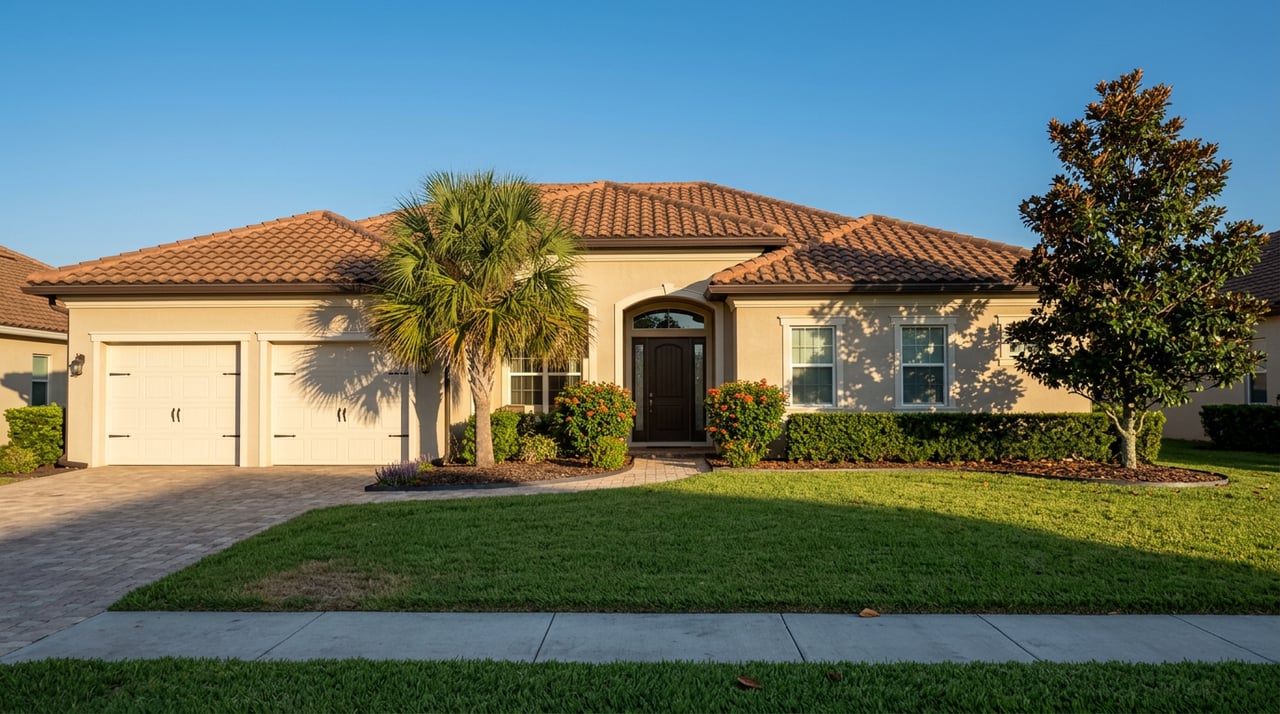
Odessa CDD Fees vs No-HOA Acreage: What to Compare
September 3, 2026
September 3, 2026
According to WUSF reporting, in early 2025, Pasco County planners floated a new interchange where an extended Rangeland Boulevard would cross the Suncoast Parkway, cutting a faster route between State Road 54 and the growing communities on both sides. Bexley residents showed up to the public hearing and said no. Their argument wasn't about traffic counts or property values. It was about identity: Bexley, they told transportation planners, is built around trails, biking, and pedestrian life, and an interchange at that spot would undercut the thing the community was designed to be. A petition against the interchange picked up more than a thousand signatures within three days.
That fight, which played out through Pasco County's public hearing process in the first half of 2025, is worth knowing before you write an offer in Odessa, because it says something the median price on a listing sheet never will. The trails, the pedestrian-first street grid, the sense of a place with its own identity that residents will organize to protect, all of that in Bexley is paid for. Specifically, it's paid for through a Community Development District, and understanding what that fee buys, and what its absence costs elsewhere in Odessa, changes how you should read two homes that look like the same number on paper.
Odessa is one of the few places within 30 to 45 minutes of downtown Tampa where a buyer can choose between a home in a master-planned community with resort-style amenities or a home on one to ten acres with a well and a septic tank, often at a similar price point. Starkey Ranch and Bexley sit on one side of that choice. The Keystone-Odessa corridor along Gunn Highway and Race Track Road sits on the other. A buyer scanning listings at $650,000 might see comparable square footage in both places and assume the carrying costs are close enough not to matter. They are not close. They are structured completely differently, and that structure is the part a list price can't show you.
Starkey Ranch sits inside the TSR Community Development District, a special-purpose unit of local government created under Chapter 190 of the Florida Statutes. A CDD exists so a developer can finance roads, water management, sewer lines, and amenities through tax-exempt bonds rather than baking the full cost into the price of the house on day one. Everyone who buys into the district then repays a share of that debt, plus the annual cost of running what got built, through a non-ad valorem assessment that lands on the property tax bill.
That assessment is really two separate charges. The debt portion repays the original construction bonds and Bexley's Series 2016 Bonds, for example, mature on May 1, 2047 The operations and maintenance portion is different. It funds the landscaping, pond maintenance, and amenity upkeep that keeps a master-planned community looking the way it does in the renderings, and it typically drifts upward rather than down. Public disclosures for Starkey Ranch have put the combined CDD assessment in the range of $2,300 to $3,400 a year, on top of whatever HOA structure applies to the specific section of the community. the number worth trusting is whichever one appears on the current tax bill for the specific parcel you're considering, not a figure from an old listing sheet.
Here's where the math actually bites. Because a CDD assessment rides on the property tax bill, your mortgage lender escrows it the same way they escrow taxes and insurance. That means the payment a builder's online calculator shows you, built around principal, interest, and a rough tax estimate, often understates what you'll actually owe once the CDD line item gets folded into escrow. The gap can run $100 to $300 a month higher than the number that first got you excited about the house. It is worth asking your lender directly how they are treating the CDD assessment in your qualification before you get attached to a specific home.
It's also not a line item you get back at tax time. The IRS treats a CDD assessment as a non-ad valorem charge, not a property tax, so it generally isn't deductible on a personal residence the way your actual ad valorem taxes are.
| Starkey Ranch or Bexley (CDD + HOA) | Keystone-Odessa Corridor (typically no CDD or HOA) | |
|---|---|---|
| Recurring assessment | CDD debt plus O&M, roughly $2,300 to $3,400 a year on the tax bill | Typically none |
| Association dues | Master association fee plus section-level HOA dues | None in most of the corridor |
| Water and sewer | Public infrastructure, built and financed through the CDD | Private well |
| Wastewater | Public sewer | Private septic system |
| How the cost shows up | Escrowed monthly by your lender | Irregular, paid out of pocket as equipment ages |
| Deed restrictions | Architectural review and enforced covenants | Typically none |
The comparison isn't only master-planned versus acreage. It's also section versus section within the same community. Public HOA disclosures have shown every homeowner in Starkey Ranch paying a $75 annual fee to the master association, which covers architectural control and deed restriction enforcement community-wide. From there it splits. Some sections have carried HOA dues around $167 a month for basic landscaping and common-area upkeep, while Esplanade at Starkey Ranch, the 55-plus villa section, has been billed at $1,050.50 a quarter, covering lawn and landscape maintenance for each home plus the upkeep of private amenities reserved for that section alone. Two homes inside the same master-planned community, both subject to the same CDD assessment, can carry HOA bills that differ by thousands of dollars a year depending on which village they sit in. Ask for the specific section's current budget rather than assuming one Starkey Ranch number applies community-wide.
The Keystone-Odessa corridor markets itself on the absence of exactly what Starkey Ranch charges for. Estate-style homes on one to five acre lots along Gunn Highway and Race Track Road, and rural parcels further out running two to ten acres, typically carry no HOA and no CDD. That freedom is real. It also means the infrastructure that a CDD would have financed collectively, water and sewer chief among them, doesn't exist. Homes in this corridor run on private wells and septic systems instead. The cost of that arrangement doesn't disappear, it just changes shape. Instead of a predictable line on the tax bill, it shows up as an occasional invoice: a well pump reaching the end of its life, a drain field needing attention, a septic tank due for pumping. There's no board setting an annual budget for it, and no monthly bill to plan around, which is exactly the appeal for buyers who value control over predictability. But it's a real cost, and it's one a lender's DTI calculation won't flag the way it flags an escrowed CDD assessment.
One number in this segment deserves a caution before you lean on it. A trailing 12-month measure of Keystone-area sales put the median price up roughly 56 percent compared with the 12 months before it. That sounds like a market on fire. It's more likely a symptom of a thin, low-volume niche where a handful of high-end estate sales can swing the median hard in either direction. A double-digit percentage move in a market segment with a dozen or fewer comparable sales tells you less about appreciation than it tells you which specific houses happened to close that year.
The question worth asking about any Odessa listing isn't "what does this cost." It's "what kind of cost is this, an escrowed assessment with debt and O&M, or irregular and out of pocket."
If you're weighing a home in a CDD community against one in the Keystone corridor, pull these before you get too far into the process:
Is a home on well and septic harder to finance or insure than one on public utilities? It isn't automatically disqualifying, but lenders and insurers will often want documentation on the well's output and the septic system's condition and age, which is exactly why pulling that history before you're under contract saves time later.
Odessa rewards buyers who read past the list price, whether that means understanding what a CDD is actually financing or knowing what a well and septic system will eventually ask of you. If you're comparing homes across Starkey Ranch, Bexley, and the Keystone corridor and want someone who can pull the actual assessment schedules and HOA budgets before you write an offer, Vincent Zeoli can walk you through what each property really costs to own, not just what it costs to buy. Let's Connect.
This article is general information, not legal, tax or financial advice. Consult a qualified professional about your situation.
Stay up to date on the latest real estate trends.

Vincent is a top producing real estate associate who is committed to making your home sales or purchase experience as easy as he can for you to reach your goal. Contact him today!